Evaluating Business Infographic Colorful Design: Vector Flexibility and Practical Application
When selecting visual assets for corporate communication, the distinction between a static image and a fully editable vector resource often determines the long-term value of the purchase. A Business Infographic Colorful Design template serves as more than just a pre-made layout; it functions as a modular design system. For professionals aged 20 to 50 managing marketing materials, internal reports, or client presentations, understanding the technical and practical implications of these resources is essential. The primary advantage lies in the format itself: openable, editable, and resizable without losing quality. Unlike raster-based alternatives, true vector files allow for infinite scaling and comprehensive customization, making them a superior choice for multi-channel business communication.
Vector Formats Versus Raster Alternatives
The most critical decision factor when comparing infographic resources is the file format. Many budget-friendly or free design resources are distributed solely as high-resolution JPGs or PNGs. While these may look acceptable on a standard monitor, they present significant limitations in a professional environment. A Business Infographic Colorful Design delivered in Vector EPS and Vector AI formats offers distinct operational advantages over raster-only options.
- Infinite Scalability: Vector graphics are defined by mathematical equations rather than pixels. This means you can resize elements from a business card icon to a billboard-sized banner without any pixelation or blurring. Raster images degrade significantly when enlarged beyond their native resolution.
- Non-Destructive Editing: With AI and EPS files, every shape, line, and text box remains an independent object. You can move, reshape, or delete elements without affecting the surrounding design. In contrast, editing a flattened JPG requires complex masking and cloning tools that rarely yield clean results.
- Print and Digital Versatility: Vectors support CMYK color profiles for professional printing and RGB for screens within the same source file. Raster files are typically locked into one color space, requiring separate versions for different media.
For teams that need to repurpose content across various touchpoints, the vector format is not merely a preference but a necessity. The inclusion of both EPS and AI files ensures compatibility across different versions of Adobe Illustrator and alternative vector software like Affinity Designer or CorelDRAW.
The Strategic Role of Color Customization
Color is rarely just an aesthetic choice in business contexts; it is a functional tool for data differentiation and brand alignment. A key feature of high-quality Business Infographic Colorful Design templates is the ease of color modification. When evaluating options, look for templates where colors are applied via global swatches or organized layer styles rather than hard-coded fills.
This distinction matters significantly during the adaptation phase. If a template uses global swatches, changing a primary brand color once will update every instance of that color throughout the entire infographic. This capability reduces hours of manual selection work to mere seconds. Conversely, templates with inconsistent color application require users to manually select and recolor individual shapes, increasing the risk of errors and visual inconsistency.
Furthermore, colorful designs serve specific cognitive functions. In data visualization, distinct hues help categorize information, guide the viewer’s eye through a narrative flow, and highlight key metrics. However, there is a tradeoff. Highly saturated, multi-colored templates can sometimes clash with conservative corporate branding or fail accessibility standards for colorblind audiences. The best vector templates provide vibrant defaults but are structured simply enough to be desaturated or adjusted to meet WCAG contrast guidelines without breaking the layout.
Assessing Structural Modularity and Shape Libraries
The claim of "100 vector shapes resizable" indicates a level of modularity that separates comprehensive design kits from simple single-page templates. When researching resources, consider whether the shapes are generic decorations or functional data containers. Effective business infographics rely on shapes that hold text, icons, or numerical data logically.
A robust library of 100 organized vector shapes allows for rapid iteration. Instead of drawing custom geometry for every new project, designers can mix and match pre-built components. This modularity supports several practical use cases:
- Rapid Prototyping: Test multiple layout concepts quickly before committing to a final direction.
- Consistent Series Creation: Maintain visual continuity across a series of quarterly reports or social media posts by reusing the same shape language.
- Custom Data Representation: Combine basic geometric shapes to create unique charts or diagrams that standard charting software cannot generate.
However, quantity does not always equal utility. A template with 100 disorganized, ungrouped shapes can be more time-consuming to navigate than a smaller, well-structured set. Evaluate the organization of the layers panel. Are shapes grouped logically? Are layers named descriptively? Proper organization is what makes a resource "easy to use" in practice, rather than just in marketing copy.
Organized Layers and Workflow Efficiency
For professionals who are not full-time graphic designers, layer organization is often the deciding factor between a usable asset and a frustrating puzzle. A Business Infographic Colorful Design with organized layers significantly lowers the technical barrier to entry. Well-structured files typically separate background elements, decorative shapes, data visualization components, and typography into distinct, labeled groups.
This separation facilitates non-destructive workflows. Users can lock background layers to prevent accidental shifts while editing foreground content. They can toggle visibility to isolate specific sections for detailed work. In poorly organized files, elements are often merged or scattered across unnamed layers, forcing users to spend valuable time reverse-engineering the designer's intent. When comparing options, preview the layer structure if possible, or look for reviews that specifically mention ease of navigation and editing speed.
Tradeoffs and Decision Factors
While vector-based colorful infographic templates offer substantial benefits, they are not the universal solution for every scenario. Understanding the limitations helps in making a balanced purchasing or download decision.
Software Dependencies
True editability requires compatible software. While the package includes a JPG for immediate viewing, unlocking the full potential of the Vector EPS and Vector AI files necessitates Adobe Illustrator or equivalent professional vector software. Free online editors often lack support for advanced vector features like global swatches, complex gradients, or specific blend modes used in premium templates. If your team lacks access to these tools, a Canva-compatible or PowerPoint-native template might be a more practical alternative, despite the loss in print quality and precision.
Learning Curve Versus Speed
Vector editing offers maximum control but requires more skill than drag-and-drop web tools. For a quick internal memo needed in ten minutes, a simplified web-based tool may outperform a professional vector template. However, for annual reports, investor decks, or printed collateral where quality and brand precision are paramount, the initial learning investment pays dividends in output quality.
Aesthetic Fit
"Colorful" is subjective and contextual. A template designed for creative agencies may be too vibrant for financial services or healthcare compliance documents. Always evaluate the underlying structure separate from the default color scheme. Ask whether the layout would still function effectively in grayscale or muted tones. If the design relies entirely on color contrast to convey meaning without other visual cues like labels or patterns, it may pose accessibility challenges regardless of how beautiful it appears initially.
What You Get: Evaluating the Complete Package
When downloading or purchasing a Business Infographic Colorful Design resource, verify the deliverables match your workflow needs. A comprehensive package should include:
- Vector AI: The native source file for full editability in Adobe Illustrator.
- Vector EPS: A universal vector format compatible with most vector editing software and older systems.
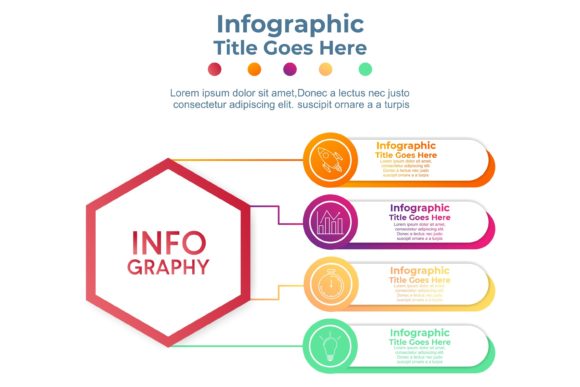
- Image JPG: A high-resolution raster preview for quick reference, sharing with stakeholders who lack design software, or use in low-stakes digital contexts.
The presence of all three formats ensures the resource remains useful across different stages of a project and for different team members. The JPG serves as a visual map, while the AI and EPS files serve as the production workspace. This multi-format approach maximizes the return on time invested in sourcing and learning the template.
Making the Final Selection
Choosing the right Business Infographic Colorful Design ultimately depends on balancing immediate needs with long-term flexibility. Prioritize vector formats if you anticipate resizing, rebranding, or printing. Value organized layers and global color swatches if efficiency and team collaboration are important. Consider the 100-shape library as a component system rather than just decoration. By focusing on these structural and functional attributes rather than surface-level aesthetics alone, you can select resources that genuinely enhance your business communication capabilities rather than simply adding to your digital asset collection.