Visualizing Emotional Abuse in Children: A Practical Guide to Using Infographic Templates for Awareness and Education
Communicating the complexities of childhood emotional abuse requires a delicate balance between clinical accuracy and empathetic design. Unlike physical injuries, psychological trauma is invisible, making it notoriously difficult to explain to lay audiences, stakeholders, or students. This is where an Emotional Abuse in Children Infographic becomes an essential communication tool rather than just a decorative element. By translating abstract psychological concepts into structured visual data, educators and advocates can bridge the gap between academic research and public understanding.
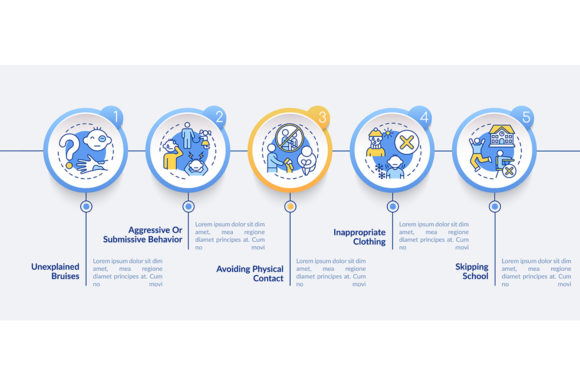
For content creators, mental health professionals, and nonprofit marketers, finding the right visual language is often the biggest bottleneck. You may have the statistics and the case studies, but presenting them in a dense report often leads to disengagement. A specialized vector infographic template solves this by providing a pre-structured narrative flow. Specifically, templates featuring a 5-step data visualization process or a process timeline chart allow you to map out the progression of abuse, the cycle of trauma, or the stages of recovery without starting from a blank canvas. These aren't just pretty pictures; they are cognitive scaffolds that help your audience process heavy information safely and effectively.
When Visual Structure Matters More Than Aesthetics
The decision to use a dedicated emotional abuse vector template usually stems from a specific communication failure. Perhaps your previous awareness campaign had high impressions but low retention, or your training materials left social workers feeling overwhelmed rather than empowered. The "when" of using these resources is tied directly to the need for clarity in high-stakes environments.
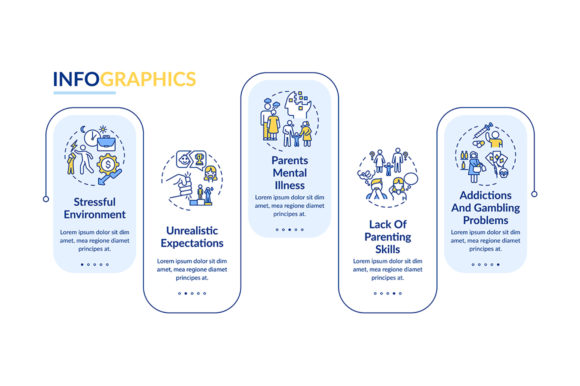
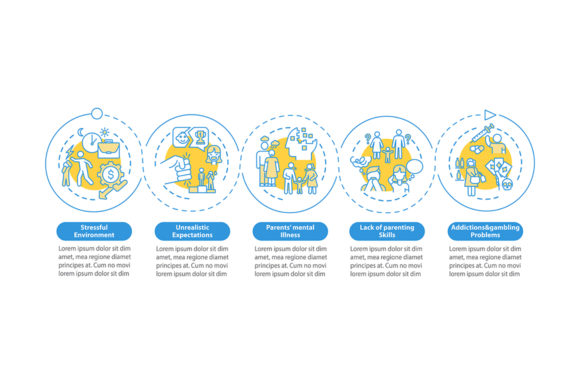
Consider the scenario of a parents' mental illness presentation. When addressing families where parental psychopathology impacts child welfare, text-heavy slides can trigger defensiveness or cognitive overload. A workflow layout with linear icons allows you to present cause-and-effect relationships neutrally. Instead of accusing language, you show a systemic flow: parental stressor, behavioral manifestation, child’s emotional response, and long-term impact. This visual distancing helps keep the audience engaged with the educational content rather than shutting down due to shame or guilt.
Educators teaching child psychology or social work also face timing constraints. You cannot spend three lectures explaining the nuances of gaslighting or neglectful attachment styles when you have a semester to cover. An infographic condenses these dynamics into a single, referenceable asset. Students can revisit the visual during fieldwork, using the linear iconography as a mental checklist for identifying red flags in real-time scenarios.
Real-World Applications Across Professional Sectors
The utility of an Emotional Abuse in Children Infographic extends far beyond clinical therapy offices. Different user groups leverage these assets to solve distinct problems in their daily workflows.
Nonprofit Fundraising and Advocacy
Grant writers and development directors know that donors respond to clarity. When applying for funding to support trauma-informed care programs, attaching a professionally designed infographic that outlines the "5 Steps of Intervention" demonstrates organizational competence. It shows you understand the problem deeply enough to simplify it. Using editable EPS or SVG files allows you to update statistics annually without paying a designer to recreate the wheel, ensuring your advocacy materials remain current and cost-effective.
Digital Content Creation and Blogging
Mental health bloggers and influencers face the challenge of stopping the scroll without being sensationalist. A clean, minimalist vector template respects the gravity of the topic while still being visually arresting. By utilizing the included JPG and PNG formats, creators can share high-quality visuals on Instagram or Pinterest that link back to in-depth articles. The key here is using the workflow layout to guide readers through a helpful resource—such as "How to Talk to Your Child About Feelings"—rather than just listing symptoms. This shifts the content from fear-mongering to solution-oriented education.
Corporate Training and HR
HR departments implementing safeguarding policies or employee assistance programs (EAPs) need accessible training aids. Employees are not clinicians; they need clear indicators of when to refer a family to professional help. A process timeline chart integrated into an internal handbook or e-learning module provides that baseline literacy. Because these templates come with vector source files, corporate communications teams can adjust colors to match brand guidelines while maintaining the integrity of the psychological messaging.
Technical Considerations for Effective Adaptation
Before downloading or purchasing an emotional abuse in children vector infographic template, users must evaluate the technical specifications against their actual production capabilities. The availability of multiple file formats—EPS, JPG, PNG, and SVG—is standard, but understanding which one serves your specific outcome is what separates amateur results from professional deliverables.
- EPS Files: Essential for print materials like brochures, posters, or conference banners. If you plan to distribute physical resources at a community center or school, you need this scalable vector format to ensure crisp lines at any size. However, you will need Adobe Illustrator or similar software to edit these.
- SVG Files: The gold standard for web-based presentations and interactive content. SVGs maintain quality on retina screens and can be animated with CSS if you have development skills. They are ideal for embedding directly into blog posts or digital reports.
- PNG vs. JPG: Use PNGs when transparency is required, such as overlaying the infographic onto a colored background in a slide deck. JPGs are better suited for email newsletters where file size impacts delivery rates and load times.
Beyond file types, consider the editability of the linear icons and text placeholders. A template is only useful if it accurately reflects your specific message. If the pre-set 5 steps describe physical abuse but your focus is verbal aggression, you need a template where every element is fully customizable. Check the layer organization before committing; a well-organized PSD or AI file saves hours of frustration when trying to swap out icons or adjust color palettes to meet accessibility standards for colorblind viewers.
Ethical Design and Audience Safety
Using design assets for sensitive topics carries an ethical responsibility that goes beyond copyright licensing. When adapting an Emotional Abuse in Children Infographic, the primary metric of success is not engagement, but safety and accuracy.
Always review the visual metaphors used in the template. Are the illustrations representative and inclusive? Do they avoid stigmatizing stereotypes about poverty, race, or family structure? Vector templates are often generic by nature, so it is incumbent upon the user to customize imagery to reflect the diverse realities of the communities they serve. Furthermore, ensure that the data visualization does not trivialize trauma. Avoid gamified elements or overly playful typography that might undermine the seriousness of the content.
Finally, pair every infographic with actionable resources. A visual explaining the signs of emotional abuse should never stand alone. It must be anchored to helplines, local support services, or further reading. The template provides the structure for awareness, but your content provides the pathway to help. By treating the infographic as a component of a larger support ecosystem rather than a standalone piece of content, you honor both the subject matter and the people who need to see it most.
Ultimately, the value of these design resources lies in their ability to make the invisible visible. Whether you are a freelancer designing for a client, a teacher preparing a lesson, or a parent seeking to understand your own history, the right visual framework transforms confusion into clarity. It turns overwhelming data into a navigable map, empowering users to recognize, address, and heal from emotional abuse with greater confidence and precision.